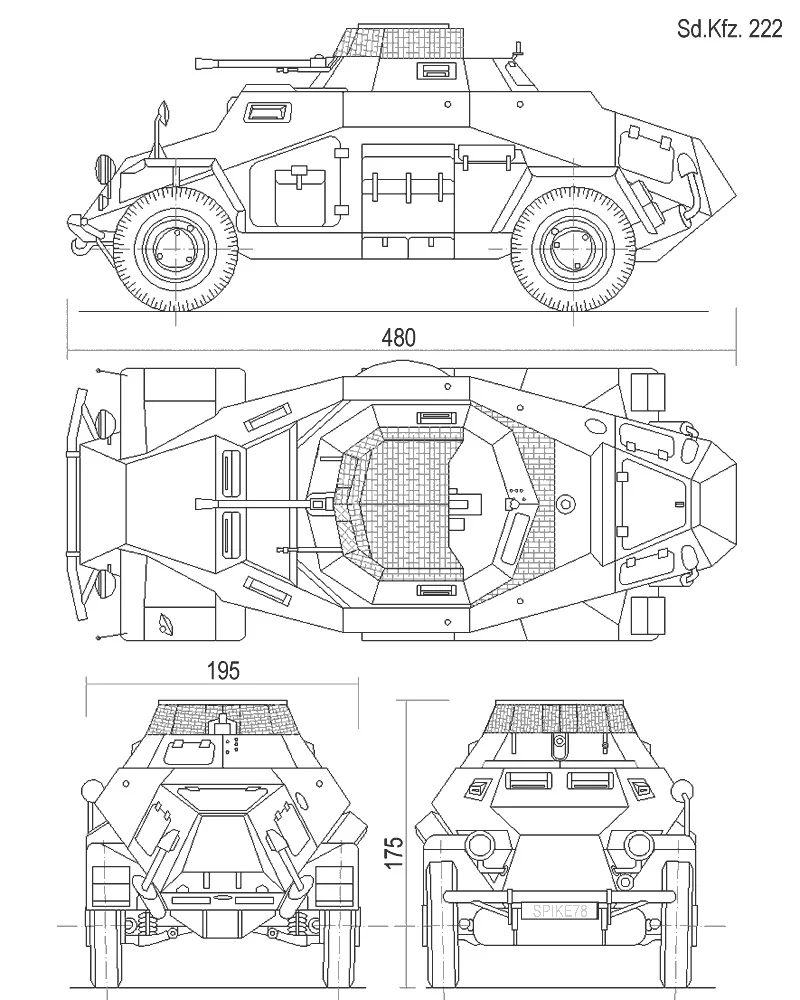
Three versions of the light armored car
The Sd.Kfz.221, 222 and 223 formed the light, four-wheeled branch of German wartime armored reconnaissance. Their similar appearance concealed different equipment: the 221 carried a machine gun, the 222 combined an automatic cannon with a machine gun, and the 223 was a radio vehicle with machine-gun armament. The U.S. Army's 1945 handbook distinguished them from the heavier eight-wheeled cars rather than treating all wheeled reconnaissance vehicles as one type. 1
Crew and turret arrangement
The three-man 222 divided the work between a commander-gunner, a driver and a radio operator-loader. A November 1943 intelligence report described a ten-sided turret and provision for laminated-glass blocks in the vision openings. The driver looked through a hinged visor in the hull front; turret slits provided views to the sides. 2
The 221 used a smaller, seven-sided turret and a two-man crew. Its wire-mesh cover occupied the forward part of the turret opening. The 223 also had machine-gun armament but carried three men. Adding a radio function therefore did not merely mean bolting an aerial onto the two-man vehicle and leaving the working arrangement unchanged. 3
Four-wheel drive and independent springing
The 222's Horch V8 drove all four wheels. The wartime ordnance catalogue described selectable two- or four-wheel steering and a gearbox with five forward speeds and one reverse. Independent springing and steering at both ends were features of the four-wheeled chassis. 3
The 1943 description gives more detail on that suspension: each wheel assembly had unequal-length radius arms and two coil springs beside one another. Its hand and foot brakes acted on all four wheels through mechanical cables. These are the arrangements recorded for the vehicle described in that report, rather than a claim that every later production configuration was identical. 2
Steel plates and grenade screens
The hinged wire-mesh frameworks above the 222 turret were intended to keep hand grenades out. They formed an overhead cage when closed, while also offering a framework for camouflage. The mesh covered the opening without forming a solid armored roof; the surrounding steel plates provided a different kind of protection. 3
For the preserved Ausf.A chassis 8101230, the Weald Foundation lists armor between 5 and 14.5 mm. Those figures describe different plates on this particular survivor. The Foundation's public data panel also records a 2 cm KwK 38, an MG 34 and a short-range radio on this example. 4
The cannon-armed 222
The 222 carried a 2 cm KwK 30 or KwK 38 and a coaxial 7.92 mm MG 34. This pairing, identified in the 1945 handbook, separates it from the machine-gun-only forms of the 221 and 223. The gun designation is a configuration distinction: the family name does not imply that all three vehicles shared one turret and one weapons installation. 1
The November 1943 American report describes the Sd.Kfz.222's cannon and coaxial machine gun as a compact installation on a central pillar, with the gunner's telescope to the opposite side. It distinguishes the movement of the weapon mount from the turret shell, connected through an arm incorporating a spring shock absorber. These details explain why an open-topped armored enclosure cannot be understood merely as a tank turret in miniature. The report concerns the installation examined by wartime intelligence, not a universal specification for all later modifications. 2
A chassis with dated manufacturing records
The Weald Foundation identifies Auto Union's Horch works as the maker of chassis 8101230 in March 1941. It gives Schichau at Elbing as the final assembler and estimates assembly in November 1941. Keeping the chassis date and estimated completion date separate preserves the difference between component manufacture and a finished armored car. Neither date establishes the first production year of the entire family. 4
Communications also separated the types in that report. It describes the 221 using flags, the 222 carrying a transmitter and receiver, and the 223 as the dedicated radio vehicle. The larger aerial on the 223 thus marked a functional difference within the reconnaissance group, not merely a different silhouette. Its extra crew position belonged to that communications role. This is a contemporary configuration comparison; the report alone cannot settle equipment changes across the entire production history. 2
Radio and flag communication
Communications differed as much as armament. The November 1943 report described the 221 using flags without a radio, while the 223 carried radio equipment. Its rectangular frame aerial stood on four supports that could fold downward and backward to clear the machine gun's field of fire. These are documented wartime equipment arrangements, not a rule that no individual vehicle was ever modified. 2
Preserved vehicles and the wider reconnaissance collection
The Weald Foundation lists a 1939 Sd.Kfz.223 Ausf.A and a 1941 Sd.Kfz.222 Ausf.A alongside its eight-wheeled Sd.Kfz.232, Sd.Kfz.261 radio car and armored half-tracks. These examples preserve several of the separate vehicle types used for reconnaissance and communications. 5
The Foundation also describes the continuing maintenance involved in preserving its vehicles, including engine and gearbox rebuilding and replacement with more appropriate components where possible. That work includes attending to the running gear as well as the outward appearance of the armored hull. 5
Sources and further reading
- U.S. War Department, TM-E 30-451, Handbook on German Military Forces, 15 March 1945, chapter VII, section VI.5
- U.S. War Department, Tactical and Technical Trends 38, 18 November 1943; transcription
- U.S. Office of the Chief of Ordnance, Catalog of Enemy Ordnance (1945), German p.41, four-wheeled armored cars; transcription in archive feed
- The Weald Foundation, Sd.Kfz.222 Ausf.A: public vehicle-data panel for chassis 8101230
- The Weald Foundation, The Collection: German reconnaissance vehicles and maintenance
Visit an Armor Museum
Explore the worldwide museum directory to find armored vehicles, collections, and visitor-planning information.
Browse armor museums