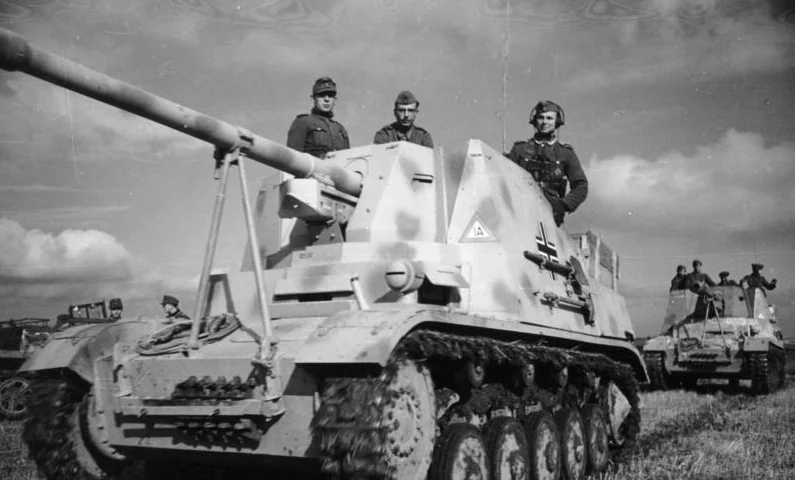
Requirement and development
The Marder II family was created in 1942 as Germany searched for rapid ways to give antitank guns tracked mobility after encounters with Soviet T-34 and KV tanks exposed the limitations of older weapons. Two distinct projects emerged from the Panzer II family. One adapted Panzer II Ausf. F-type chassis to carry the German 7.5 cm PaK 40/2. The other used Panzer II Ausf. D/E and related Flammpanzer chassis with modified captured Soviet 76.2 mm guns designated PaK 36(r). Both projects reused automotive systems that were no longer ideal as front-line tanks. Their parallel development explains why “Marder II” describes a concept and family more accurately than a single uniform vehicle. 1, 2, 3
Layout and engineering
Marder II covers more than one Panzer II-based antitank conversion. Tank Encyclopedia separates the Sd.Kfz.132, armed with captured Soviet 7.62 cm guns, from the Sd.Kfz.131 with the German 7.5 cm PaK 40. New-built vehicles, factory conversions, and field conversions also appear separately in surviving production accounts. Those categories are the reason exact family totals vary between summaries: adding every converted chassis into one number can obscure which weapon, hull version, and production route a specific figure actually represents. 1, 2, 3
This split also matters when reading photographs and specifications. The Soviet-gun Sd.Kfz.132 and PaK 40-armed Sd.Kfz.131 differ in weapon, superstructure details, and ammunition arrangements. A family article can discuss both, but it should not use one variant’s ammunition load or gun dimensions as a universal Marder II figure. 1, 2
Armament and direct-fire role
The two Marder II branches carried different guns. Sd.Kfz.131 mounted the 7.5 cm PaK 40/2, one of Germany’s standard and effective wartime antitank weapons. Sd.Kfz.132 used captured Soviet 76.2 mm guns modified for German ammunition and service, turning battlefield matériel into a useful antitank resource. Both weapons were far more powerful than the guns of the obsolete Panzer II tanks that provided the chassis. The tradeoff was a limited-traverse mount and restricted ammunition space rather than a fully integrated turret. The family’s historical importance lies precisely in that conversion: it gave light-tank chassis enough firepower to remain relevant in a role their original armament could no longer perform. 1, 2, 3
Protection and survivability
Marder II vehicles retained the thin armor of the Panzer II lower hull and added only light shielding around the gun crew. The fighting compartment remained open, exposing the crew to artillery fragments, small-arms fire from above, weather, and close assault. The high silhouette also made the vehicles easier to detect than later low casemate Jagdpanzers. These vulnerabilities were not design oversights so much as accepted consequences of an emergency program intended to field stronger guns quickly. The vehicles were not built to lead attacks or exchange fire with tanks from exposed positions. Their survivability depended heavily on terrain, concealment, supporting units, and disciplined employment. 1, 2, 3
Mobility, reliability, and logistics
Using Panzer II components gave the Marder II family a readily available tracked base, established maintenance knowledge, and enough mobility to accompany many German formations. The added gun and superstructure increased weight and shifted the chassis away from the balance of the original light tank, but the vehicles remained far easier to reposition than towed heavy antitank guns. The two major variants differed because the Ausf. D/E and Ausf. F chassis did not share identical suspension and layout. Automotive reliability also depended on the condition of older or converted vehicles. By 1942–43 the underlying Panzer II system was mature but no longer ideal, reinforcing the Marder’s role as an interim solution. 1, 2, 3
Variants, production, and naming
Marder II covers more than one Panzer II-based installation. Its main distinction is between vehicles using the German 7.5 cm Pak 40 and those carrying the adapted Soviet 7.62 cm weapon. The March 1945 U.S. inventory recognizes both gun types on Panzer II-related chassis, but some of its detailed designation pairings are inconsistent. Gun caliber and the actual running gear should therefore be identified before applying an Sd.Kfz. number or a performance table to a photographed vehicle. 5
Operational service
Marder II vehicles served principally on the Eastern Front but also appeared in other theaters and with allied forces. They provided mobile antitank companies with weapons capable of dealing with armored threats that the original Panzer II could not defeat. The open configuration and light armor encouraged employment from concealed positions or as mobile reserve firepower rather than as assault tanks. Combat attrition, chassis wear, and the arrival of later Marder III, StuG, and Jagdpanzer systems gradually reduced their importance. Nevertheless, the family remained in service because Germany could not discard useful mobile guns during a period of expanding fronts and persistent shortages of modern armored vehicles. 1, 2, 3
Limitations and tradeoffs
Marder II vehicles were top-heavy, lightly protected, open-topped, and constrained by the size and load capacity of a light-tank chassis. Ammunition stowage and crew workspace were limited, and the gun could traverse only through a restricted arc. The Sd.Kfz.132 additionally depended on a captured-weapon ammunition and maintenance solution that complicated standardization, while the Sd.Kfz.131 still placed a heavy PaK 40 on a small chassis. These shortcomings were acceptable for an interim anti-tank carrier but made the family poorly suited to prolonged close combat. Its success was therefore situational: a strong gun gained mobility, but the platform never became a balanced general-purpose armored vehicle. 1, 2, 3
Assessment and related development
Marder II reused Panzer II-related chassis for guns substantially more powerful than the original tank armament. The captured Soviet and German-gun forms were not interchangeable configurations. Their exposed fighting spaces also separated them from later enclosed tank destroyers. Identification begins with both the running gear and the weapon, not the Marder name alone. 1, 2, 3, 4, 5
Sources and further reading
References and further reading are listed below. Image identification, credit and reuse terms remain with each photograph.
- Tank Encyclopedia — Marder II Sd.Kfz.131 (secondary source; not primary certification)
- Tank Encyclopedia — Marder II Sd.Kfz.132
- Tank Encyclopedia — 7.5 cm PaK 40
- Bundesarchiv Bilddatenbank — Panzerjäger / Marder II image records
- U.S. War Department, TM-E 30-451 VII.V.6: self-propelled artillery list (March 1945), transcription
Visit an Armor Museum
Explore the worldwide museum directory to find armored vehicles, collections, and visitor-planning information.
Browse armor museums