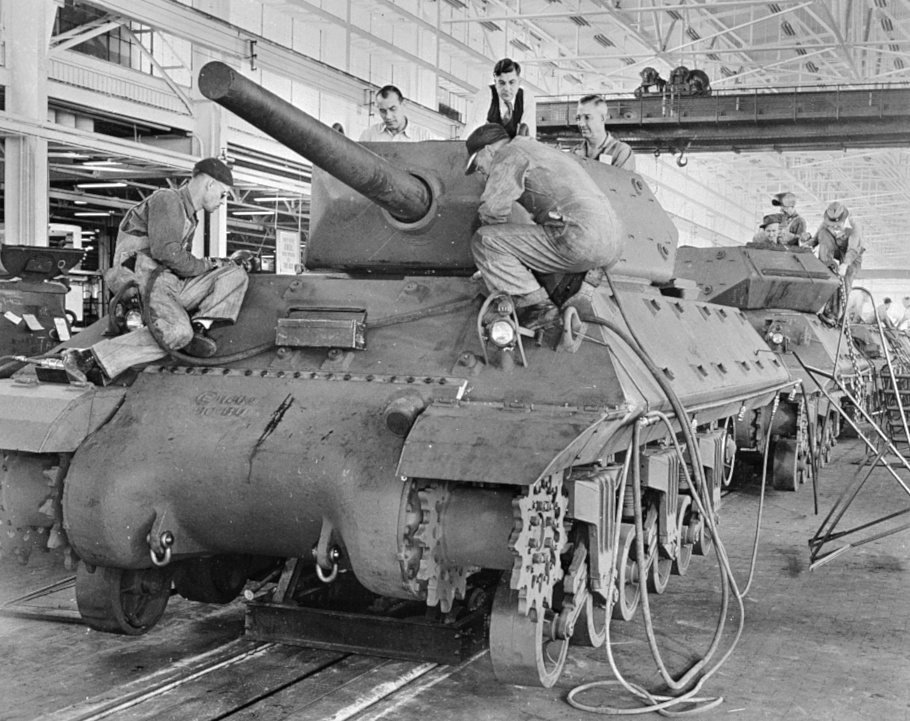

A vehicle for tank-destroyer doctrine
The U.S. Army created tank-destroyer units around the idea that mobile antitank forces could respond to enemy armored penetrations. That doctrine produced a demand for a fast self-propelled gun with enough antitank power to engage tanks while remaining more mobile and less heavily armored than a conventional medium tank. 1, 2
The M10 mounted a 3-inch gun in an open-topped turret on a chassis derived from the M4 medium-tank family. Its silhouette and tracked mobility made it look tank-like, but its intended employment, thinner protection, and open fighting compartment reflected the tank-destroyer mission. 1, 3
The M10 and M10A1
The gun and turret were heavy enough that manual traverse could be difficult on slopes. Counterweights added to the turret rear became one of the family’s recognizable features. M10 and M10A1 production used different Sherman-related automotive foundations, but both served the same basic tactical purpose. 1
Tank destroyer battalions used M10s in North Africa, Italy, and northwest Europe. In practice they were often dispersed to reinforce infantry or other formations rather than massed in the doctrinal antitank reserve envisioned before combat. 1, 2
British Achilles conversions
British forces rearmed a portion of their M10 fleet with the powerful 17-pounder antitank gun. These vehicles became known as Achilles and provided a mobile mount for a weapon with substantially better armor-piercing performance against later German tanks than the original U.S. 3-inch gun. 3
The Achilles remained structurally part of the M10 family, but its armament and British employment history justify recording it explicitly rather than burying it as an alias. 3
About “Wolverine”
Modern references often call the M10 “Wolverine.” The name is useful as a search alias, but surviving wartime evidence does not support treating it as an official U.S. service nickname. The archive therefore uses M10 Gun Motor Carriage as the primary designation. 2
Sources and further reading
Representative source set used for this profile. Primary image source and reuse terms are listed with the image.
- U.S. Army Center of Military History, Mobility, Shock, and Firepower
- Christopher R. Gabel, Seek, Strike, and Destroy: U.S. Army Tank Destroyer Doctrine in World War II
- Pansermuseet, M10 Achilles