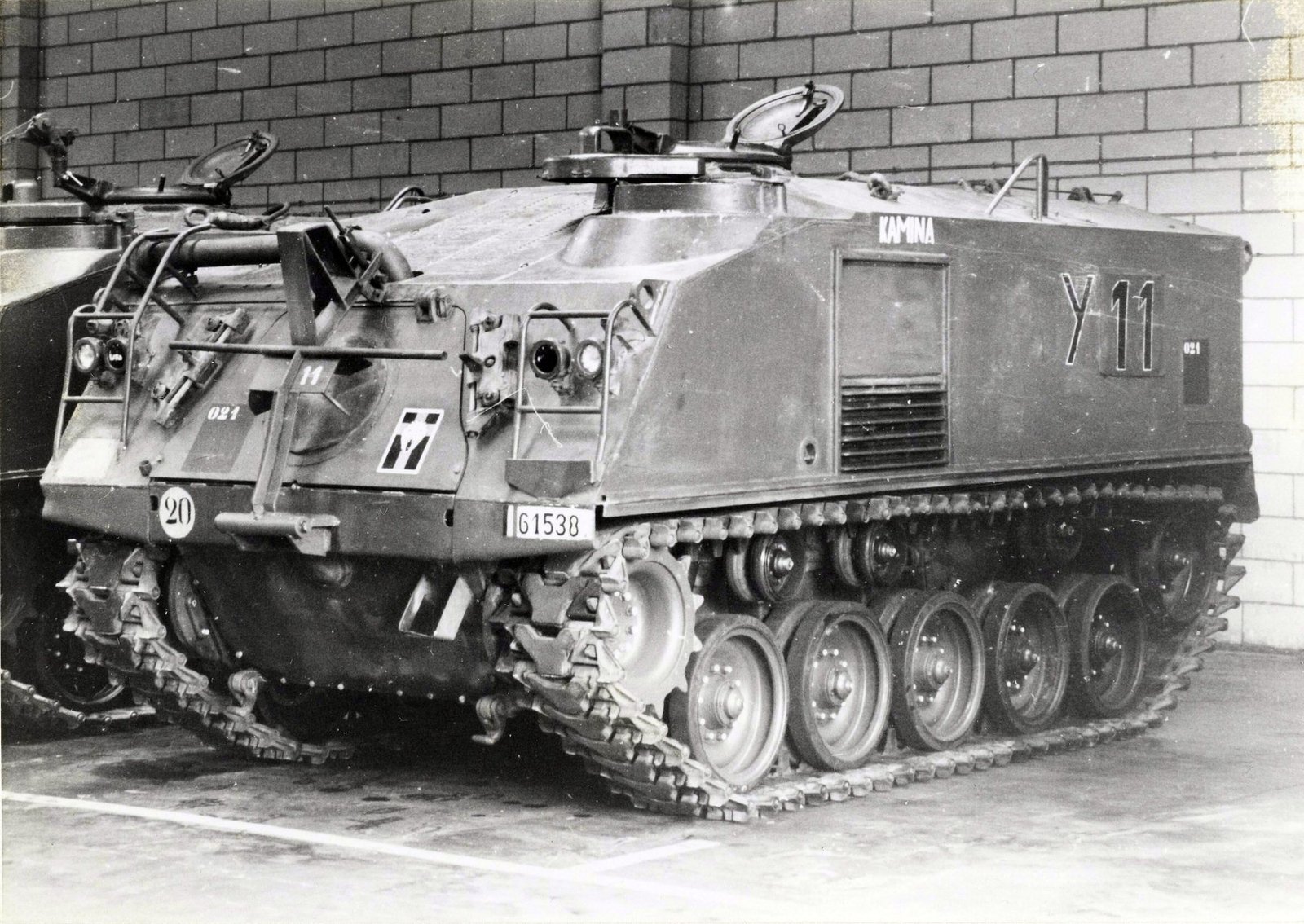
.jpg)
Development and requirement
Late-World War II and postwar experience drove the U.S. Army toward a fully tracked carrier that could move an infantry squad under all-around armor. The result was the T18, standardized as M75. Army periodicals recorded its combat use in Korea, including evacuation under artillery fire, demonstrating the practical value of a roofed armored carrier compared with open half-tracks. 1, 2
Design and fighting role
The M75 provided a large enclosed troop compartment, heavy armor for an APC, and a powerful gasoline engine. Its size, weight, and cost reflected a design philosophy that emphasized protection and tracked mobility, but those same characteristics limited economy and strategic flexibility. A commander’s .50-caliber machine gun provided local defensive fire. 1, 2
Service and evolution
M75 service was relatively brief. The Army quickly sought a lower, cheaper, amphibious replacement, leading to the M59. Even so, the M75 established several features that became standard expectations for postwar U.S. carriers: roof protection, rear troop access, and the ability to transport an infantry squad within a fully tracked armored hull. 1, 2
Archive boundaries
M75 is kept separate from M59 and M113 because each represents a distinct U.S. APC generation. The M75’s importance is developmental and historical rather than the size of its production run. 1
Sources and further reading
Representative source set used for this profile. Primary image source and reuse terms are listed with the image.
- U.S. Army Armor magazine, July-August 1953 — M75 combat use
- U.S. Army Infantry magazine, 1966 — postwar APC development