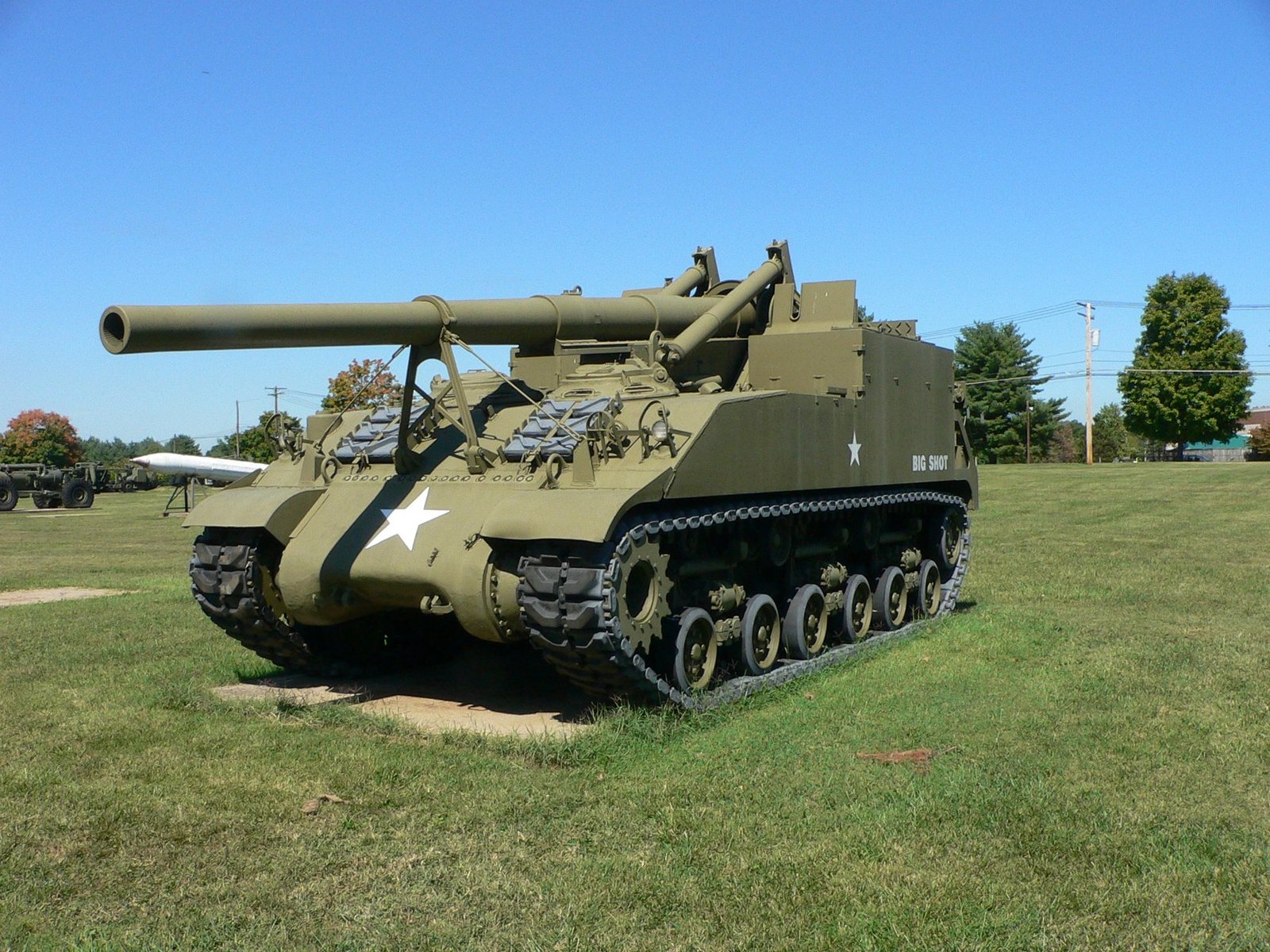
The M40 and M43 were the U.S. Army’s late-war heavy self-propelled artillery family, using a common Sherman-derived chassis for either a 155 mm gun or an 8-inch howitzer.
Developed as successors to the M12, the two vehicles used a widened, lengthened M4-family chassis with horizontal-volute suspension and a large open rear fighting platform. The common carriage allowed different heavy artillery weapons to share automotive and support arrangements. 1, 2
Operational use
A pilot M40 saw combat in Europe in 1945; the family served more extensively after the war, including in Korea. The M43’s higher-angle 8-inch howitzer complemented the longer-ranged 155 mm M40. 1, 2
Role and significance
The family foreshadowed later U.S. efforts to place multiple artillery calibers on related chassis and marks the transition from improvised wartime conversions to purpose-designed heavy self-propelled artillery. 1, 2
Sources and further reading
Representative source set used for this profile. Primary image source and reuse terms are listed with the image.