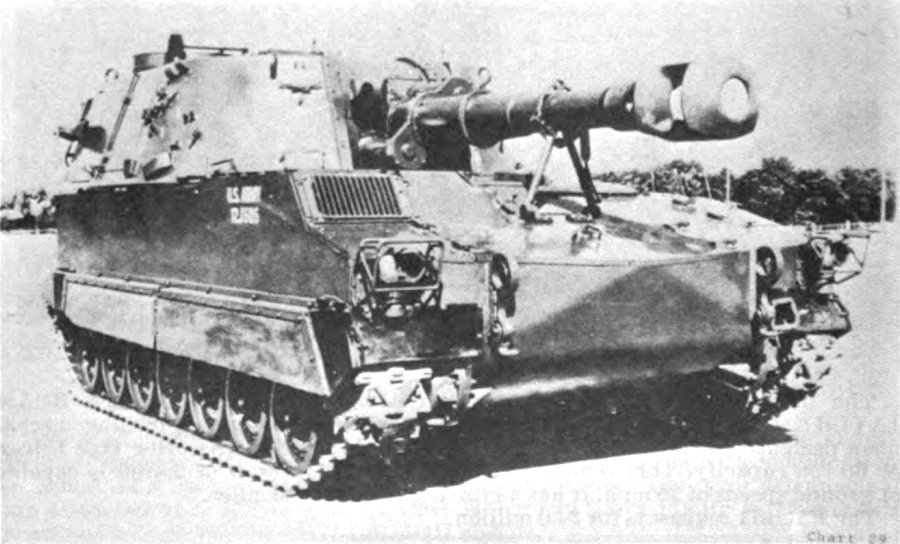

A mobile artillery requirement
The Army established a requirement after World War II for self-propelled artillery that could support armored forces without depending on towed guns and separate prime movers. The prototype lineage that became the M109 began with the T196 in the 1950s and shifted to a 155 mm weapon as requirements matured. 1
The 105 mm M108 became standard in armored and mechanized divisions in 1963, but the Army soon moved toward the 155 mm M109 because the larger caliber offered a more useful combination of range, destructive effect, and ammunition options. The M108 therefore became the short-lived sibling while the M109 became the enduring family. 2
From early M109s to Paladin
Successive M109A1, A2, and A3 changes improved the gun, suspension, reliability, and other systems. The M109A6 Paladin added automated fire control, navigation, communications, and faster displacement after firing, changing the operational rhythm of a system whose basic ancestry reached back to the 1950s. 3, 4
That history makes the M109 a useful reminder that a “family” can persist while much of the machinery inside it changes. New-build components, depot conversions, turret structures, guns, electronics, and support vehicles must not be counted as though every modernization were a wholly new vehicle population. 3, 4
M109A7 and Bradley commonality
The M109A7 modernization replaced the older automotive foundation with a new chassis, engine, transmission, suspension, and steering system using substantial commonality with Bradley Fighting Vehicle components. The Army accepted the first low-rate initial-production M109A7 in 2015. 4, 5
That relationship is a cross-family logistics connection rather than a claim that the M109 became a Bradley derivative. The artillery cab and weapon lineage remain M109, while the newer chassis deliberately shares components to simplify sustainment within armored brigades. 4, 5
Why self-propelled artillery is separate from tanks
The M109’s armor and tracks let it survive and maneuver with armored formations, but its principal mission is indirect fire. Treating it as a “tank” because it has tracks, armor, and a large gun obscures the doctrinal difference between protected direct-fire maneuver and artillery support. 3
Sources and further reading
Representative source set used for this profile. Primary image source and reuse terms are listed with the image.
- U.S. Army Acquisition, “Testing of the M109 Series Howitzer: A Case Study”
- U.S. Army Center of Military History, The Army and the Flexible Response
- U.S. Army Weapon Systems Handbook, M109A2/A3 Self-Propelled Howitzer
- U.S. Army PEO Ground Combat Systems, Ground Combat Systems fact sheets
- U.S. Army, first M109A7 delivery