_(cropped).jpg)
Development and requirement
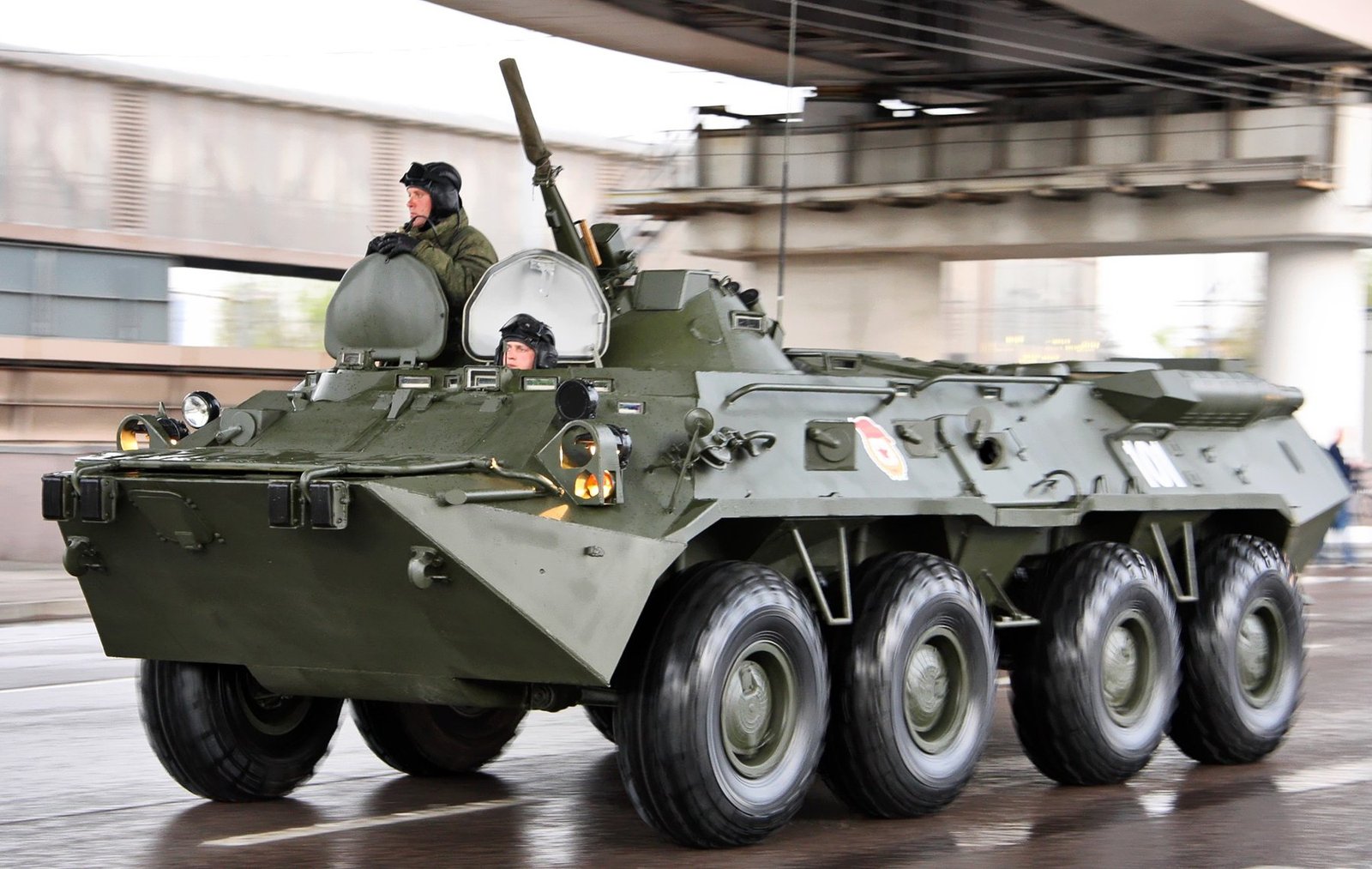
The BTR-80 addressed major shortcomings of the BTR-70 while preserving the familiar Soviet 8x8 amphibious carrier concept. A single diesel engine replaced the earlier twin gasoline installation, the rear hull was reorganized, and side doors were redesigned to make dismounting somewhat safer. Later BTR-82 development sought further improvements without replacing the basic chassis family. 1, 2
Design and fighting role
Baseline BTR-80 vehicles use a high-elevation 14.5 mm turret and carry a motor-rifle squad inside a lightly armored, amphibious hull. BTR-80A and BTR-82A versions add a 30 mm cannon, increasing firepower enough to blur the line between APC and wheeled IFV. The BTR-82 also incorporates automotive, protection, communication, and stabilization improvements. 1, 2
Service and evolution
BTR-80-series vehicles have been used by Russia and many export operators in conventional war, peacekeeping, internal-security, and patrol missions. The family’s longevity reflects the large installed fleet and the practicality of upgrading turret systems and electronics even though the basic side-door layout remains less convenient than modern rear-ramp APCs. 1, 2
Archive boundaries
The archive classifies the family primarily as an APC because protected transport remains the base mission. Cannon-armed BTR-80A/BTR-82A variants are acknowledged as IFV-like, but are kept in the same family rather than split solely by turret. 1
Sources and further reading
Representative source set used for this profile. Primary image source and reuse terms are listed with the image.
- U.S. Army TRADOC ODIN Worldwide Equipment Guide — BTR-80
- U.S. Army TRADOC ODIN Worldwide Equipment Guide — BTR-82